Single vs Double Sided Wheel Ring Lights: Which to Choose
Last updated: November 2026 · Reading time: about 7 minutes
Almost every wholesale inquiry we receive about wheel ring lights ends with the same question in different words: should I take single-sided or double-sided? The two look similar in a product photo and differ by a few hundred grams of aluminium, yet they produce very different results on a truck at night. This guide walks through what actually changes between the two, and the five points worth checking before you place an order.
1. What single-sided and double-sided really mean
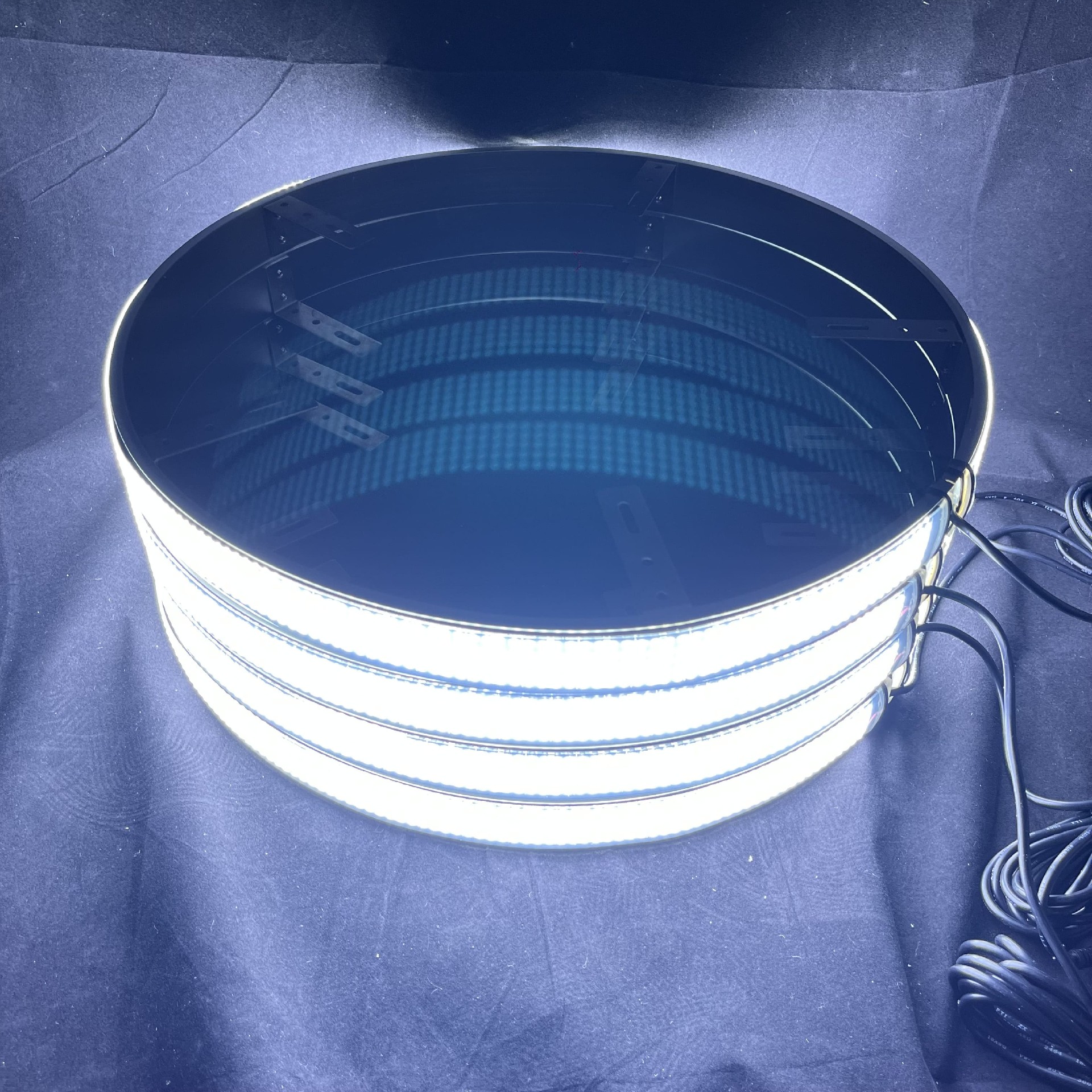
A wheel ring light is a circular LED board that mounts behind the wheel lip. "Single-sided" means the LEDs sit on one face only, pointing outward toward the wheel and fender. From the side of the vehicle you see a clean, thin ring; the glow lands on the rim edge and the brake caliper behind it.
"Double-sided" means the board carries LEDs on both faces. One side still throws light outward, while the second side lights the inner area of the wheel barrel and the brake assembly. The visible result is a thicker, more saturated halo, and the light stays readable when you look at the truck from an angle rather than straight on.
Both types are built on the same platform in our line: a sealed ring with an aluminium-silicon composite housing, IP67 rated, running on a 12–13.8V constant-voltage circuit. The difference is light direction, LED count, wattage and heat load.
2. Side-by-side comparison
| Item | Single-sided | Double-sided |
|---|---|---|
| Light direction | Outward only | Outward and inward |
| Visual effect | Thin, crisp ring; clean lines | Thick halo, brighter from any angle |
| Typical wattage | 28–45W for 15–17 inch rings | 50–100W, up to 140W on 4-row sets |
| Heat load | Lower; easier on long drives | Higher; housing heat dissipation matters |
| Clearance needed | Less depth behind the lip | More depth; check the wheel barrel |
| Install time | Shorter, simpler routing | Slightly longer, more wiring care |
| Best for | Daily driven trucks, subtle OEM-plus look | Show builds, lifted trucks, night photos |
3. Five questions that decide it
3.1 How should the wheel look when it is parked?
Single-sided gives a defined outline; you see a ring, not a glow. Double-sided fills the wheel opening with light, so the rim reads almost like a lit disc. If the customer's reference photo shows a bright, evenly filled circle, they are looking at double-sided.
3.2 Where will people actually see it?
Straight-on photos flatter both types. From a low angle, in traffic, or in a video where the truck moves, double-sided holds its brightness much better because the inward-facing LEDs keep the wheel lit as the viewing angle changes. Car show and content creators usually end up on double-sided for this reason.
3.3 What size and offset is the wheel?
Our rings come in 15, 17 and 20 inch diameters, in 4, 5, 6 and 10 row layouts. Double-sided boards are deeper: on a wheel with a shallow barrel or a tight brake package, the extra depth has to go somewhere. Measure the inner lip diameter and the depth behind the lip before choosing, and confirm clearance with the brake caliper on large brake upgrades.
3.4 Can the vehicle's circuit handle the wattage?
Both types run on a 12–13.8V constant-voltage drive, which keeps brightness stable when voltage moves and avoids the stroboscopic flicker that cheap resistor-driven rings show. Four rings at 40W each is 160W, roughly 13A at 12V — fine on a dedicated ACC circuit with a relay, but not something to hang on an existing accessory wire without checking.
3.5 What is the selling price band and the return risk?
Double-sided costs more to build and generates more heat, so returns tend to come from two places: fitment depth and installation mistakes, not from the LEDs themselves. If your market is price-sensitive and mostly daily drivers, single-sided sells faster. If your buyers are lift and show customers, double-sided carries the higher ticket.
4. Matching rows, wattage and brightness
Row count is the other half of the decision. A 5-row 17 inch ring at 40W produces 4300LM of pure white light — plenty for a visible ring at night. A 4-row double-sided set at 140W reaches 18,800LM, which is the top of our range and suits builds where the wheel light is a feature, not an accent.
Two practical rules from our production line:
- More rows, more heat. Density raises output and temperature together. Rings with more rows rely on the aluminium-silicon composite housing to spread heat; running them at full output for hours in summer is the harshest test.
- Match colour to the build, not to the trend. Pure white reads clean and OEM-like; white-and-amber dual colour gives a switchback look that fits trucks with amber accent lighting; RGBW with Bluetooth app control and music sync suits show trucks and content creators. Pick one and keep the whole set consistent — mixed colour temperatures on four wheels look like a fault, not a feature.
5. Installation points that affect the result
Most complaints about wheel ring lights trace back to installation, not the product. The common ones:
- Wire to a switched ACC source, not a constant live wire. A ring left on a constant circuit will drain the battery and is the fastest way to earn a one-star review.
- Use the constant-voltage driver that ships with the ring. Skipping it to save ten minutes brings back flicker and uneven brightness at low voltage.
- Keep the connector dry. The ring itself is IP67 rated and handles rain, snow, mud and shallow water crossings, but a connector left hanging open at the harness end is not. Seal it and route it away from spray.
- Respect the temperature range. The product is rated for −30°C to 70°C. That covers winter starts and summer highway heat, but it does not cover a ring buried in mud with no airflow.
- Test before final assembly. Power up all four rings on the bench, check colour consistency across the set, then mount.
6. A buyer's checklist before ordering
If you are buying for resale rather than for one truck, these eight items are worth confirming in writing with any supplier, including us:
- Ring diameter and row count, with the actual measured inner lip size
- Single-sided or double-sided, and the LED count per ring
- Rated wattage and luminous flux at that wattage
- LED chip model (2835 is the common choice on our rings)
- Housing material and how heat is managed
- IP rating, plus the operating temperature range
- Voltage range and whether a constant-voltage driver is included
- Warranty terms and what the warranty actually covers
A supplier who answers all eight without hedging is a supplier you can plan a season around. One who answers three and sends a catalogue is not.
7. FAQ
Can I mix single-sided and double-sided on the same truck?
Technically yes, but the two produce visibly different halos. On a vehicle where all four wheels are seen together, the mismatch is obvious. Keep one type per vehicle.
Is double-sided too bright for daily driving?
Brightness is a matter of taste and local rules. Double-sided at 50–80W is a common choice for daily driven trucks; the 140W four-row set is aimed at show and off-road builds. Dimming through an app is available on RGBW versions.
Will a 17 inch ring fit my wheel?
Ring size follows the inner lip diameter of the wheel, not the vehicle model. Two trucks with the same model can carry different aftermarket wheels, so measure the wheel you are actually fitting. We do not publish vehicle fitment lists for that reason.
Do the rings work in winter?
The rated range starts at −30°C, so cold starts are within spec. The practical winter issue is road salt and ice on the connector, not the LED board.
What is the difference between 4-row and 5-row at the same wattage?
More rows spread the same power across more LED packages, which usually means a more even ring with slightly lower drive current per chip. Fewer rows concentrate output and run each chip harder. Neither is better in the abstract; the ring should look uniform, and that is what to check on a sample.
8. Choosing with confidence
Single-sided is the safe, clean, everyday answer; double-sided is the answer when the wheel light is supposed to be the point of the build. Decide from the reference photo your customer sends, the wheel's measured depth, and the circuit you can support — then match rows and colour to that decision rather than the other way round.
We have been building lighting in Shenzhen since 2011, and we keep specifications, driver details and warranty terms in writing so buyers can check them before ordering. If you want the spec sheet for a specific ring size, or a sample to test on a wheel, send us the diameter, row count and colour you are considering.